
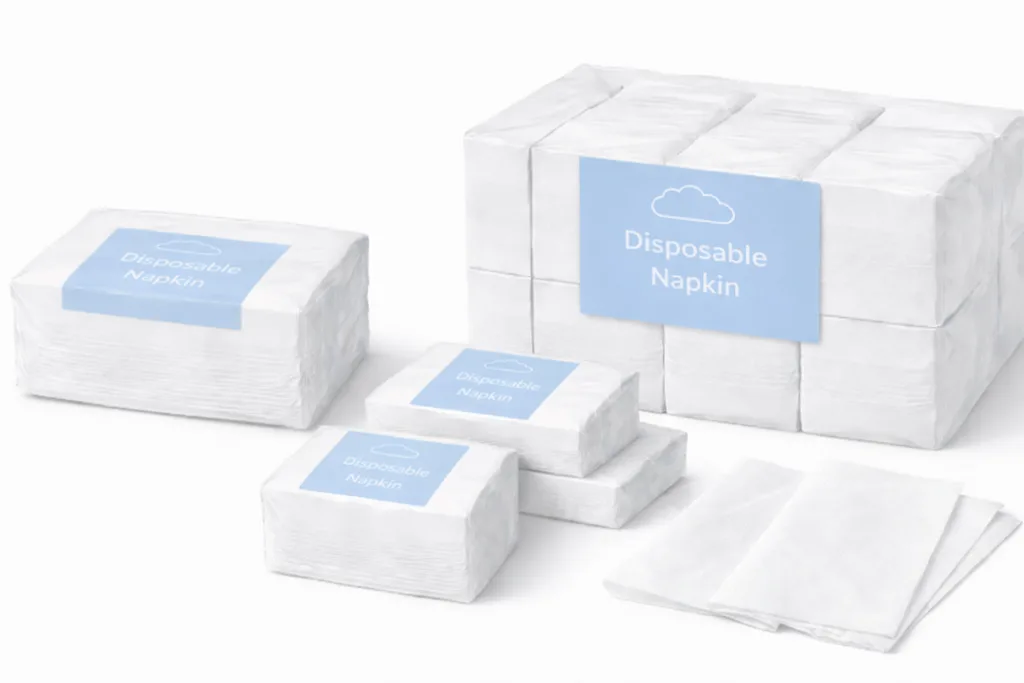
Paper is the quietest category in a hotel's supply list and one of the most reliably noticed. Nobody compliments a toilet roll, but a guest who tears through a facial tissue, or finds a napkin that pills onto a dark suit, registers it — and the category is a genuine repeat-purchase line with predictable annual demand.
It is also a category where quotations are almost impossible to compare at face value. "2-ply toilet roll, 200 sheets" describes perhaps twenty different products at perhaps forty different prices. Our hotel disposables procurement checklist maps the full room assortment; this guide goes one level down into the paper lines specifically, and sets out the numbers to put on the order.
The Five Paper Lines in a Hotel
| Product | Where it sits | The specs that define it |
|---|---|---|
| Toilet tissue roll | Guest bathroom | Ply, sheet count or roll length, sheet size, core diameter, embossing |
| Facial tissue (box or soft pack) | Bathroom vanity, bedside, desk | Ply, sheet size, sheets per box, carton design, pop-up fold |
| Hand towel (folded or roll) | Public washrooms, back of house | Fold type, absorbency, wet strength, dispenser compatibility |
| Napkins | Restaurant, bar, banqueting, room service | Ply, size and fold, embossing, printing, food-contact compliance |
| Kitchen/jumbo roll | Back of house, housekeeping trolleys | Wet strength, absorbency, roll length |
Guest-facing lines and back-of-house lines follow different logic. Guest-facing paper is judged on feel and appearance; back-of-house paper is judged on absorbency per unit cost and on dispenser fit. A buyer who applies one standard to both either overspends on the service corridor or embarrasses the guest room.
Ply Is a Description, Not a Specification
Ply counts the layers laminated together. It correlates with perceived quality, but it does not fix performance, because a 3-ply tissue built from three very light plies can be thinner and weaker than a well-made 2-ply. The specifications that actually pin the product down are these four, all of which have defined international test methods in the ISO 12625 series for tissue paper and tissue products:
- Grammage (g/m²) — the mass per unit area, determined under ISO 12625-6. This is the single most useful comparison number, and the one most often missing from a quotation. Ask for grammage per ply and total.
- Thickness and bulk — determined under ISO 12625-3, which covers thickness, bulking thickness and apparent bulk density. Bulk is what makes a tissue feel substantial; a well-embossed sheet gains bulk without gaining fibre.
- Tensile strength and stretch — ISO 12625-4 measures tensile strength, stretch at maximum force and tensile energy absorption. This is what stops a sheet tearing in the hand.
- Wet tensile strength — ISO 12625-5, measured after soaking. Critical for hand towels and kitchen rolls; deliberately limited in toilet tissue, which must disperse rather than survive wetting.
- Water absorption — ISO 12625-8 gives absorption time and absorption capacity by a basket-immersion method. The number that matters for hand towels, where a faster, higher-capacity sheet means fewer sheets per dry.
The practical consequence: when you receive two quotations, ask each supplier for grammage, thickness and the relevant tensile figures, stated with the ISO method used. A supplier who can produce the test data is a different kind of supplier from one who cannot, and the exercise usually explains the whole price gap without any negotiation.
Toilet Roll: The Numbers That Decide Cost
| Specification | What to state on the order | Why it matters |
|---|---|---|
| Ply | 2-ply or 3-ply, with grammage per ply | Ply alone does not fix quality; grammage does |
| Sheet count and sheet size | Both — or the total roll length | "200 sheets" is meaningless without sheet dimensions; two rolls with the same count can differ by a third in paper delivered |
| Roll diameter and core diameter | Both, in mm | Core diameter governs dispenser fit; roll diameter governs whether it fits the holder at all |
| Fibre | Virgin, recycled or blend | Drives cost, brightness and softness, and determines which eco-claims are available |
| Embossing and finish | Pattern, and whether ply-bonded | Adds bulk and perceived softness; ply-bonding stops layers separating in use |
| Wrap | Individually wrapped or bulk-packed | Individually wrapped rolls read as more hygienic in guest rooms and cost more |
Two operational details that buyers learn the hard way. First, roll and core diameter must be checked against the actual dispensers in the property, not against the previous supplier's catalogue — a roll that is 5 mm too wide is a full delivery of unusable stock. Second, for guest bathrooms most properties want a dispersible tissue that breaks down readily in the drainage system; specifying high wet strength here is an error that ends in a maintenance call.
The presentation detail worth its small cost is the folded or stamped first sheet on the spare roll. It signals that the room has been serviced, and housekeeping teams can do it without a consumable.
Facial Tissue and Napkins
Facial tissue is the softest product a hotel buys, and softness is driven by fibre furnish, ply construction and the crêping process rather than by ply count. Specify sheet size, sheets per box, ply and grammage, then decide the format: flat-fold boxes, pop-up interfolded cartons, or soft packs for turndown and pool areas. Carton artwork is where boutique properties differentiate — and because printed board sets the minimum order, it is also where a small property's cost per box jumps. Neutral cartons with a branded band are the usual compromise for a first order.
Napkins are a food-contact product, which changes the compliance conversation. In the European Union, materials and articles intended to come into contact with food sit under the framework Regulation (EC) 1935/2004, and your supplier should be able to supply a declaration of compliance for the napkin as supplied — including any inks used in printing. Where napkins are printed, confirm the ink system is suitable for food contact; this is the most common gap in a napkin quotation.
Napkin size and fold drive the table setting: cocktail, luncheon and dinner formats carry different sizes and different folds, and banqueting operations often specify a heavier grammage for a dinner napkin than for a bar napkin. Colour-fastness is worth a sample test — a dyed napkin that transfers colour to damp hands is a complaint waiting to happen.
Eco Claims: What Can Actually Be Substantiated
Sustainability questions now appear in most hotel tenders, and paper is one of the few categories where the claims are well-defined and verifiable.
- Fibre certification. Chain-of-custody certification from the Forest Stewardship Council (FSC), the Programme for the Endorsement of Forest Certification (PEFC) or an equivalent independent scheme is the standard evidence for responsibly sourced virgin fibre. For recycled fibre, delivery notes under EN 643 — the European standard for grades of paper for recycling — are the accepted alternative where FSC or PEFC recycled claims are not used.
- EU Ecolabel. Commission Decision (EU) 2019/70 establishes the EU Ecolabel criteria for tissue paper and tissue products, covering emissions to air and water, energy consumption, fibre sourcing and restrictions on hazardous substances. Under its fibre-sourcing criterion, at least 70% of the fibre allocated to the product or production line must come from sustainably managed forests meeting an independent chain-of-custody scheme, and/or from recycled material. If a tender asks for an eco-labelled product, this is usually the label it means.
- Unbleached and recycled aesthetics. Natural-brown tissue and napkins have moved from budget signal to sustainability signal in many markets. They are a positioning choice, not a quality compromise — but confirm the guest-facing lines still meet your softness benchmark before rolling them out.
The rule is the same as for any claim: the certificate must name the product or the production line you are actually buying. A mill-level certificate that does not cover your SKU is not evidence.
Ordering, Packing and Container Planning
Paper is bulky and light, which makes it the classic volumetric cargo: containers fill up long before they reach a weight limit. Three consequences for the buyer.
First, carton dimensions and pieces per carton matter more than the ex-works unit price. Ask for the loading plan alongside the quotation; a supplier who can load 15% more product into the same box has just beaten a 10% price difference.
Second, paper is an ideal filler line in a consolidated shipment. Because it is light, it can ride alongside dense lines — cleaning chemicals, amenity kits, tableware — without pushing the container over weight. This is exactly the logic behind mixed-container ordering for hospitality supplies, and paper is usually the line that makes the cube work.
Third, store it properly. Tissue absorbs humidity, and paper stored badly at destination loses bulk and picks up odour. Specify moisture-barrier packing for humid destinations and long sea legs.
For properties consolidating their whole disposables programme, the paper lines sit naturally alongside amenities and tableware in the hotel and dining range, and alongside the janitorial lines covered in our wholesale cleaning supplies guide.
FAQ
How do I compare two toilet roll quotations fairly? Put five numbers side by side: grammage per ply, ply count, sheet size, sheet count (or total roll length) and core diameter. Then confirm the roll fits your dispensers. Most apparent price gaps close once those are equal.
Is 3-ply always better than 2-ply? No. A heavy, well-embossed 2-ply can outperform a thin 3-ply on both feel and strength. Compare grammage and thickness, not layer count.
Should guest bathroom tissue have high wet strength? No — the opposite. Toilet tissue should disperse in water. High wet strength belongs in hand towels and kitchen rolls, not in the guest bathroom.
What certification should I ask for on eco claims? FSC, PEFC or an equivalent chain-of-custody certificate for fibre sourcing, EN 643 delivery notes for recycled content, and the EU Ecolabel under Decision (EU) 2019/70 where a tender specifically asks for an eco-labelled tissue product. Check the certificate covers your SKU.
Can we print our logo on napkins and tissue cartons? Yes. Printed board and printed napkins both carry a plate cost that sets the minimum order, so the usual first step is a neutral product with a branded band or sleeve, moving to full printing once volumes justify it. For printed napkins, confirm food-contact suitability of the inks.
What should a paper products quotation include? Grammage per ply, ply count, sheet size and sheet count, core diameter, embossing, the packing unit and cartons per pallet, and the fibre chain-of-custody certificate behind any eco claim. Prices, minimum quantities and lead times are confirmed with the quotation rather than fixed in a catalogue.
Planning your paper programme for the year? Send us your property count, your dispenser types and your target quality tier for guest-facing versus back-of-house lines — we will come back with specifications, test data and a container plan. → Request a quote from HOPE International
Sources consulted: ISO 12625-3 (thickness, bulking thickness and apparent bulk density); ISO 12625-4 (tensile strength, stretch at maximum force, tensile energy absorption); ISO 12625-5 (wet tensile strength); ISO 12625-6 (grammage); ISO 12625-8 (water-absorption time and capacity, basket-immersion method); Commission Decision (EU) 2019/70 (EU Ecolabel criteria for graphic paper, tissue paper and tissue products); EN 643 (European list of standard grades of paper and board for recycling); Regulation (EC) 1935/2004 (materials and articles intended to come into contact with food).