
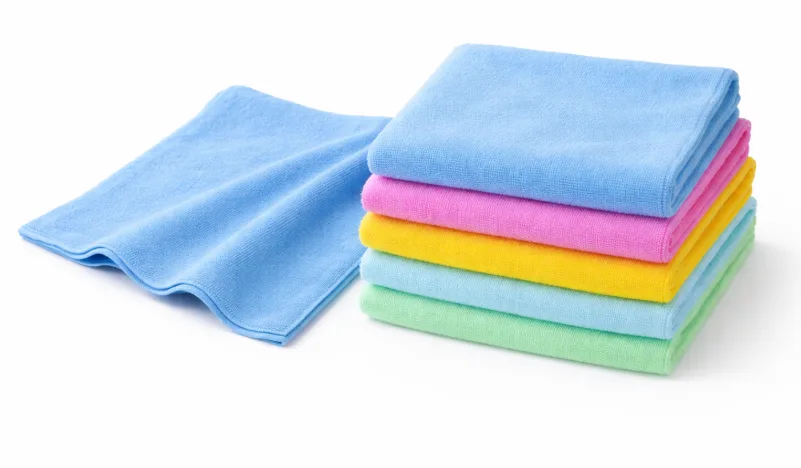
Two offers for "microfibre cloth, 300 gsm, 40 × 40 cm, blue" can sit 20 per cent apart with the same three numbers on both. The spread is almost never the gsm. It is the blend split, whether the filament has actually been split, the edge finish, and a wash-life claim that no one on either side of the table has tested. A cloth that loses its pile after fifty cycles in a laundry running 90 °C with softener costs more per clean than the dearer cloth that survives three hundred — and the cost lands on your customer's contract, not on the purchase order you compared.
The second thing that separates these quotations is dye-lot discipline, and it only shows up on the second shipment. If you supply a colour-coded cleaning operation, a blue that drifts half a shade between lots is a quality complaint from the client's auditor, not a cosmetic issue. Specify the colour the way a textile buyer does — reference, tolerance and fastness test — and that complaint never starts.
The specification that actually sets the price
| Attribute | Common commercial bands | What it changes |
|---|---|---|
| Weight (gsm) | 200–240 / 260–300 / 320–350+ | Absorbency and perceived quality; the single biggest material cost driver |
| Blend | 80/20, 70/30 and 90/10 polyester / polyamide | Polyamide is the dearer component and carries the dirt-grabbing performance; 90/10 is a price blend |
| Filament state | Split or non-split | Non-split fabric can hit the same gsm at lower cost and underperform on grease; ask for the split ratio, not the word "microfibre" |
| Filament fineness | Stated in dtex per filament | The only objective way to compare two "microfibre" offers; put a maximum dtex in the purchase order |
| Construction | Warp-knit terry, waffle, suede/glass, pearl weave | Decides the job: terry for general soil, waffle for liquid pick-up, suede for glass |
| Size and tolerance | 30 × 30, 40 × 40, 40 × 60 cm, ± tolerance stated | Dimensional tolerance after first wash is where "same size" offers diverge |
| Edge finish | Overlocked, ultrasonic-cut, banded, silk edge | Overlocking adds labour; ultrasonic-cut is cheaper and can be specified not to scratch glass |
| Colour | Reference plus tolerance | Colour-coded accounts need lot-to-lot consistency, not just "blue" |
Vendor literature on this category routinely advertises up to 500 washes. Treat that as a ceiling claimed by the maker, not a performance figure: the claims we have seen come without wash temperature, detergent, load, or any definition of what counts as end of life. If wash life matters commercially — and in a contract-cleaning account it is the whole economics — name the test in the purchase order: cycles at a stated temperature and detergent, with pile height or water pick-up measured at the start and at the end. A supplier willing to be measured that way is telling you something; so is one who is not.
Colour-coding: specify the system, not the colour
Most European and many Gulf and Asian cleaning specifications follow the four-colour scheme developed by the UK's National Patient Safety Agency and still referenced across NHS guidance: red for sanitary areas including toilets, washrooms and bathroom floors, blue for general areas such as wards, offices and public areas, green for catering and food areas, and yellow for isolation areas. The scheme covers cleaning items — cloths (reusable and disposable), mops, buckets and aprons — rather than the chemicals.
One detail saves money and gets missed: Health Facilities Scotland guidance states that colour coding is not required for single-use microfibre mopping systems. If your account runs single-use flat mops, you may be paying a four-colour premium on stock you could buy in one colour. Ask the question before you split the order four ways.
For the colour itself, three fields belong in the purchase order: the colour reference, the acceptable deviation against it, and colour fastness — ISO 105-C06 for laundering and ISO 105-X12 for rubbing, with the grade you will accept. Then require the dye-lot number on the carton. Without the lot number on the box, a shade complaint cannot be traced and becomes a credit note instead of a replacement.
RFQ fields, ordered by how much they move the price
- Weight in gsm, with the tolerance you will accept.
- Blend split and whether the filament is split, with a maximum dtex.
- Construction and intended job per SKU.
- Size and the dimensional tolerance after one wash.
- Edge finish per SKU.
- Colour reference, deviation tolerance and fastness grades.
- Wash-life test basis, if wash life is a contract term.
- Packing: per-piece polybag, banded sets, inner count, carton count and print.
- Labelling per destination market (see below).
- Annual volume and call-off pattern.
Inspection, sampling and the acceptance number
Cleaning textiles carry no statutory acceptance quality limit, so the figure is contractual — a supplier who answers "AQL 1.5, as usual" is quoting a medical-device convention at you; the EN 455-1 figure of AQL 1.5 belongs to EU examination gloves and the 2.5 figure under 21 CFR 800.20 to the US market for the same, neither to cloths. Sample under ISO 2859-1, general inspection level II, and define the defect classes yourself: gsm out of tolerance, size out of tolerance, shade deviation beyond the agreed limit, edge stitch defects, loose filaments, and print or label errors. Then name the stages: in-process check, DUPRO at around the 20 per cent mark, pre-shipment inspection before sealing, and a loading check. SGS, Bureau Veritas, Intertek, QIMA and TÜV reports are all normal on this category, as is your own inspector.
Ask for inspection against the defect classes written into your purchase order rather than a house standard, and for the pre-shipment report to be shared before the container is sealed.
Packing, cube and the two tariff lines
Microfibre is a cube commodity: it fills the box long before it troubles the payload. As planning figures a 20ft container takes roughly 26–28 m³ of export cartons, a 40ft roughly 55–58 m³ and a 40HQ roughly 65–68 m³ — typical ranges for this category, not a loading guarantee. Compression packing changes those numbers materially, so ask whether the carton count assumes vacuum or banded packing.
| Commercial term | What to fix in the purchase order |
|---|---|
| Packing hierarchy | Per-piece bag or banded set → inner pack → carton, with inner count, carton dimensions and gross/net weight per SKU |
| Pallet configuration | Pallet type, tiers, and whether the price is pallet-in or loose-loaded |
| Container planning | Cube ranges above, with cartons per container taken from the loading plan rather than estimated |
| Incoterm and port of loading | State both. An EXW number, a FOB Ningbo number and a DDP number are three different prices |
| HS lines | Cleaning cloths: 6307.10. Mops, including flat-mop heads with a frame or handle: 9603.90. A cloth-and-mop set is classified by the item giving it its essential character, which is normally the mop |
| Price basis | Per piece and per carton, in USD, with an indicative band against the current polyester and polyamide yarn index rather than an open-ended price |
That HS row is the most common quiet error on a janitorial order. One purchase order covering cloths and flat-mop kits is two tariff lines, and a packing list that calls the whole thing "cleaning products" invites the broker to apply one rate to everything. Split the lines on the commercial invoice before the goods move. Where a kit genuinely is a retail set, say so and let the classification follow the essential-character rule instead of discovering it at the border.
Labelling and market compliance
These are consumer and professional goods, not medical devices, so the compliance questions are different — and they are labelling questions, which means they are cost questions.
| Market | What applies | Status |
|---|---|---|
| EU | Fibre composition labelling under Regulation (EU) No 1007/2011. Annex VI lists floorcloths and cleaning cloths among products for which inclusive labelling is sufficient, so where the goods are of the same type and composition a per-piece fibre label may not be needed | Confirmed with the quotation |
| EU | General Product Safety Regulation (EU) 2023/988, applicable since 13 December 2024: an EU-established responsible person must be identified, with name, postal and electronic address shown on the product or packaging and in online listings | Confirmed with the quotation |
| EU | REACH Annex XVII entry 43 restricts azo colourants that release the listed aromatic amines above 30 mg/kg in textile articles in prolonged skin contact; test methods are the EN 14362 series | Confirmed with the quotation |
| US | Fibre content and country-of-origin identification under the textile labelling rules, plus care labelling where the article is covered | Confirmed with the quotation |
Two practical notes on that table. The inclusive-labelling allowance in Annex VI is worth real money on a high-count order — confirm it against the current consolidated text for your exact article rather than assuming it. And a Chinese mill test report to GB 18401 is not a REACH report: the national standard and the EU restriction use different amine lists and limits, so ask for testing against the EN 14362 methods when the destination is the EU.
MOQ, samples and lead time
Stock samples and development samples are two different asks. A stock sample settles hand-feel, gsm and shade against your reference this week. A development sample answers whether a specific blend, dtex and edge can be made to your tolerance, and it runs through yarn sourcing, knitting, dyeing and finishing — dyeing is the step that sets the calendar, because a colour has to be matched and approved before anything is cut.
Lead time on this category should be quoted as production plus dye approval, not production alone. A quoted 30 days that silently excludes shade approval is a missed shipment.
Ask for lead time quoted with the dye-approval step shown separately, and for the approved shade reference to be confirmed in writing before bulk dyeing starts.
Responsibility and change control
Three fields belong in your supplier file for a non-medical textile line: the legal manufacturer of record, the EU responsible person under the GPSR, and the party who signs off the labelling for each destination. Name them before the first order, because the responsible person's address has to be printed, and reprinting cartons after the fact is the most expensive way to learn that.
Then change control, which is where the third order goes wrong rather than the first. Ask for a written product change notification policy: how many working days before a change of yarn supplier, blend split, dye house or knitting site, and whether your written agreement is required. In this category a quiet change of dye house is the single most likely cause of a shade complaint on a colour-coded account.
Ask for the dye-lot number on the carton so a shade complaint can be traced to a lot, and for the lot-code key with the first shipment.
When microfibre is the wrong buy
If the account washes in municipal laundries with chlorine bleach and fabric softener and will not change that, microfibre's advantage is destroyed in the laundry and a cotton or blended cloth may serve the contract better. The same applies to a site that loses 30 per cent of its cloths a month: at that attrition a disposable nonwoven wiper is the honest recommendation, and saying so is cheaper than winning one order and losing the account.
FAQ
How is the minimum first order set — by piece, by colour or by container? It is quoted per SKU and per colour, because each colour is a dye lot; a four-colour programme is four minimums, which is why single-colour single-use mop systems can be cheaper to start.
Can you send a stock sample against our colour reference before we order? Ask for one where the line is already in production; it is the fastest way to settle shade and hand-feel before anyone pays for a development run.
Which documents come with the shipment? Commercial invoice and packing list split by HS line, the fibre-composition statement, the test reports for the destination market, the dye-lot list per carton range, and the inspection report where an inspection was agreed.
How is the price held, and against what? Per piece and per carton in USD, with an indicative band tied to the polyester and polyamide yarn indices and a stated validity window. An open-ended price in this category usually has room in the gsm or the blend.
What to send us
Send the gsm, blend, size and colour set you need, your wash regime, and the annual volume with the call-off pattern. You get back the specification table above filled in per SKU, carton and pallet figures for your own cube maths, and a written dye-lot and shade-tolerance basis.
Start from the microfiber cleaning cloths wholesale page, compare it against the cleaning cloth supplier range, or browse the full cleaning supplies wholesale category. For colour-coded programmes see supplies for cleaning companies and for room-attendant trolleys hotel cleaning supplies. The wider category sits in our wholesale cleaning supplies sourcing guide.