A private label wipe gets killed at the ingredient panel, not at the price. The two expensive versions of that: a retailer's own compliance team rejects a preservative system after the artwork is cut and the first run is in production, or a container clears customs on a tariff heading that the formula does not actually support and the broker re-rates the whole invoice. Both are decided by the liquid, and the liquid is usually the last thing a buyer specifies and the first thing a supplier offers to "keep standard".
So spend the time on the formula brief. The fabric is a commodity conversation; the liquid carries the regulatory risk, the claim risk and, as it turns out, the duty rate.
The preservative rule that actually bites in the EU
The single hardest line in a European wipe specification is the preservative. Methylisothiazolinone is prohibited in leave-on cosmetic products in the EU, and wet wipes are named as leave-on: Commission Regulation (EU) 2016/1198 amended Annex V of the Cosmetics Regulation and the prohibition has applied since 12 February 2017. The Scientific Committee's finding behind it was that 100 ppm MIT is not safe and that no safe concentration had been adequately demonstrated for leave-on use.
That matters commercially because MIT-based systems are cheap and still circulate in offer sheets for non-EU markets. A supplier quoting you one formula "for all markets" either has a non-MIT system, in which case ask to see it named, or has not looked at your destination list. Preservative choice is not an interchangeable line item — it is the line that decides whether your pack is legal where you sell it.
Here is what buyers most often exclude, and what the exclusion costs:
| What buyers exclude | Why they exclude it | What it changes in the quotation |
|---|---|---|
| Fragrance / parfum | Allergen declaration, retailer policy and parent preference on newborn-positioned lines | Little on cost; removes the fragrance allergen labelling work |
| Alcohol | Skin tolerance positioning on newborn ranges | Shifts the preservative burden, since alcohol was helping |
| Methylisothiazolinone | Prohibited in leave-on products in the EU, wipes included | A real cost line: the replacement system is dearer and needs its own challenge testing |
| Formaldehyde-releasing preservatives | Restricted or disfavoured in several markets and by most retail buyers | Same as above; also drives the shelf-life conversation |
| Dyes and surplus botanical extracts | Allergen risk and label length with no functional gain | Usually cheaper to leave out, which is the rare easy decision here |
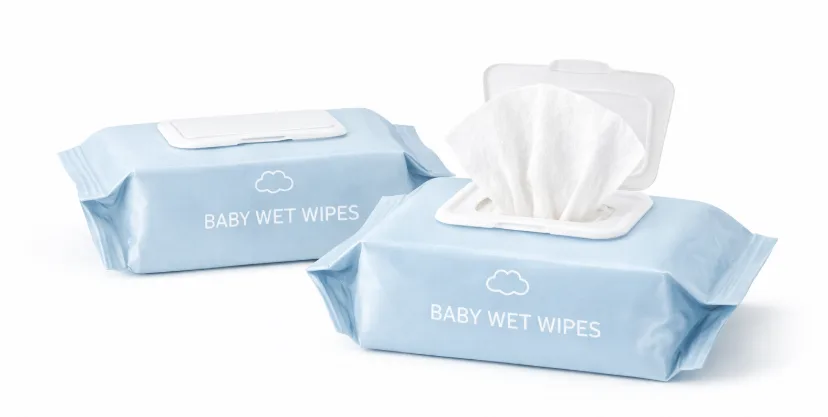
That leaves the brief most newborn-positioned ranges actually run: a short list that is mostly purified water, a mild cleanser, a skin conditioner, a pH adjuster and a preservative system permitted in each destination market. Our catalog specification for baby wet wipes is a 40 to 60 gsm spunlace sheet with a 99% water, fragrance-free liquid, in packs of 20 to 100. Whichever supplier you use, ask for the exact ingredient panel and the test reports behind it per destination market rather than a single global formula.
One thing not to do: claim what you have not tested. "Hypoallergenic", "dermatologist tested" and any newborn-safety wording are claims that need supporting data on file for your product, not for a product like yours. Keep any claim off your artwork that the test file does not carry; a supplier willing to print one is a liability you are paying for.
Where two quotations for the same wipe differ
In rough order of money:
- Preservative system and the challenge testing behind it. The biggest hidden spread, and invisible on a sales sheet.
- Spunlace grammage and sheet size. A 5 gsm difference and a centimetre off the sheet is a real unit cost change that no one notices at the pack.
- Lotion add-on weight. How much liquid per sheet, which is how a pack can feel dry and still meet the piece count.
- Lid and pack format. A hard resealable lid, a sticker flap and a flow-wrap are three different tooling and material positions.
- Testing scope. Microbiology and stability per batch versus a type test on file from an earlier lot.
- Print minimums. Each language version is its own minimum, not a share of one.
The plastic marking most briefs forget
If the nonwoven contains plastic — and spunlace blends commonly do — the EU marking obligation applies. Under Commission Implementing Regulation (EU) 2020/2151, in force since 3 July 2021, wet wipes containing plastic with a surface area of 10 cm² or more must carry a marking stating that the product contains plastic and must not be flushed, in the official language or languages of each Member State where it is placed on the market.
That is an artwork problem with a lead-time consequence: the marking has format, colour and minimum-size rules, and it has to sit on a panel you have probably already filled. Settle it before plates are cut, and settle the fibre composition in the same conversation, because it is the composition that decides whether the marking applies at all. If your supplier tells you stickers are acceptable, ask them to point at the provision and the date it covers — transitional allowances in this area were time-limited and are worth verifying rather than taking on trust.
RFQ fields, ordered by how much they move the number
- Destination market list, because it sets the preservative options, the label language set and the claim set before anything else.
- Fabric type and grammage, with a tolerance, plus sheet dimensions.
- Liquid: lotion add-on weight, fragrance-free or scented, and the preservative system named rather than "standard".
- Pieces per pack and the size split across your range.
- Pack format and lid type, with the tooling position stated — yours or theirs.
- Fibre composition, and whether the plastic marking applies to your pack.
- Test list: microbiology, stability, skin compatibility where you intend any tolerance wording, and whether testing is per batch or type.
- Artwork: colours, languages, barcode ownership, who signs off, and the claim set in writing.
Inspection and the AQL question
Sampling is the uncontroversial half: pull against ISO 2859-1, general inspection level II, with the lot defined as the production batch.
The acceptance number is where buyers drift, and the drift comes from a glove standard. Wipes carry no statutory acceptance figure; the category where a number is written into law is examination gloves, where the US applies AQL 2.5 under 21 CFR 800.20 and the EU AQL 1.5 under EN 455-1. A supplier quoting "the usual AQL 1.5" for wipes is reading a glove standard at you. Define the classes yourself with named examples: lid not sealing, pack count short, sheets welded together, liquid short or uneven, lot code missing or illegible, wrong language version, carton crush. We accept the inspection company you nominate, or we use the inspection company we work with on a continuing basis.
Packing, cube and the tariff line that catches people
| Commercial term | What to fix in the purchase order |
|---|---|
| Packing hierarchy | Sheet count → pack → inner → export carton → pallet, with the count at every level, carton dimensions and gross and net weight per SKU |
| Count reconciliation | Reconcile by pack, not by carton. An 80-count and a 100-count at the same cartons-per-pallet is the most common invoice dispute in this category |
| Loadability | As planning figures only: 20ft roughly 26–28 m³, 40ft 55–58 m³, 40HQ 65–68 m³. Wipes cube out well before they weigh out |
| Pallet configuration | Pallet type, cartons per tier, tiers per pallet, pallet-in or loose, and whether heat-treated pallets are required at your port |
| Incoterm and port of loading | State both. EXW, FOB Ningbo and DDP are three different prices; compare like with like and check your own duty line first |
| HS line | The formula decides the heading. EU classification practice puts detergent-impregnated wipes at 3401.11, wipes with no soap or detergent at 3307.90, and skin-care wipes whose surfactant acts only as an emulsifier at 3304.99. Confirm the heading against your own tariff for the formula you actually buy |
| Price basis | Indicative USD per carton against current pulp, resin and nonwoven costs, with a stated validity window rather than an open-ended price. An open-ended price here usually means there is room in the grammage or the add-on weight |
That HS row is the one worth reading twice. EU classification rulings have separated these wipes by what the liquid does, not by what the pack looks like: a detergent-impregnated wipe sits at 3401.11 because the detergent gives it its essential character, a refreshing wipe with no soap or detergent at 3307.90, and a make-up removal wipe at 3304.99 because its surfactant is only an emulsifier. Reformulate the liquid and you can move the heading and the duty rate without changing a single thing a consumer would notice. If your broker is classifying from last year's invoice and your supplier changed the surfactant, you have an exposure nobody is looking at.
Price, minimum order quantity and lead time are confirmed with each quotation, against your specification and destination market.
Regulatory route and who carries the liability
| Market | Route for a baby wipe | What you have to hold on file |
|---|---|---|
| EU | Cosmetic product under Regulation (EC) No 1223/2009: a Responsible Person established in the EU, a Cosmetic Product Safety Report, CPNP notification, and Annex V compliance on preservatives | The Responsible Person entity, the safety report, the CPNP reference and the preservative justification |
| US | Cosmetic under MoCRA: facility registration covering establishments that manufacture or process cosmetics for US distribution, importers included, renewed every two years, plus product listing filed by the responsible person | The facility registration number, the product listing, and the responsible person named on the pack |
| UK and other markets | National cosmetic regimes with their own notification, labelling language and local representative obligations | The local responsible person and the market-specific label set, settled before artwork is cut |
Three fields belong in your supplier file whichever column you land in: the legal manufacturer named on the pack, the EU Responsible Person or authorised representative where you sell into Europe, and the US agent or responsible person where one applies. Ask every supplier for all three in writing, with entity names and addresses as they will appear on the label — on a private label range that name is usually yours, which means the liability is too. We confirm ours for your destination market with the quotation rather than printed on a web page.
Change control and traceability
The third order is where this goes wrong. Ask for a written change notification policy covering a change of nonwoven supplier, surfactant, preservative system, lid supplier or production site. A change of surfactant is the one most often treated as internal — it is not, because it can move both your allergen declaration and your tariff heading.
Ask for the lot code on the pack and the export carton so a complaint traces to one batch, and for the lot-code key with the first shipment. We notify specification changes in writing; that notification is for your records — we do not hold production for a written approval from you. If your retailer's quality system needs an approval gate, raise it at the purchase order stage so it sits in the terms. Ask also for the retention sample policy and the shelf life claimed, with the stability data behind the months on the pack, and for how payment terms are set against first and repeat orders.
When private label is the wrong call
Below roughly a container a year per SKU, a bespoke liquid is usually a false economy: you pay the challenge testing, the artwork cycle and the print minimums on a volume that cannot absorb them. Buy a compliant standard formula in a neutral pack and apply your own label until the volume justifies a formula of your own.
What to send us
Send your destination market list, your fabric and grammage target, the pieces per pack and size split, your pack and lid format, and the claim set you intend to print. Whichever supplier receives them, ask for a specification sheet per SKU, the list of tests the quotation is made against, the fibre composition for your marking assessment, and carton and pallet figures for your cube maths.
Start from the baby wipes private label supplier page, or take in the whole baby care products wholesale range. Worth opening alongside a first brief: wet wipes for private label where the adult and household formats sit, baby diapers wholesale if the range will be awarded together, and the broader hygiene products supplier catalogue. For how carton and pallet figures are set out on a mixed hospitality load, see our guest room paper products specifications.
FAQ
How is the minimum first order set — by pack count, by formula or by print design? Usually by the largest of three minimums: the liquid batch for your formula, the nonwoven roll width you have specified, and the print run for your film or lid label. On a multi-language launch the print minimum is almost always the binding one. The figure itself comes with the quotation.
Can you send samples before we commit to a formula? Yes. We supply samples free of charge. Assessing a sample at your target grammage, sheet size and pack count settles sheet feel, wetness and lid action before anyone pays for tooling.
Which documents should come with the shipment? Ask for the invoice and packing list split by HS line, the batch record and microbiology result for the lot shipped, the ingredient panel as printed, the fibre composition statement for your plastic-marking assessment, and the inspection report where agreed. Tell us the destination market and we will send the exact documentation package for that product.
How is the price held, and against what? In USD per carton against current pulp, resin and nonwoven costs, with a stated validity window. An open-ended price in wipes usually means there is room in the grammage or the lotion add-on weight.